Hoodoo & Rootwork

About this tradition
Hoodoo is the African-American folk magic tradition, known regionally as conjure and rootwork: a practical, condition-focused system rather than a formal religion, one that works alongside any faith and was classically practiced inside Black Protestant Christianity, whose Bible is the tradition's central magical book. The practitioner, the root doctor or conjure worker or spiritual reader, works for hire on specific outcomes, and the work's sequence is its structure: the reading first, by tarot or pendulum or bone-throwing or Bible work, to diagnose the condition, then the work itself. The condition categories cover money and luck, love and reconciliation, protection and uncrossing, justice and the courtroom, domination and control, and the tradition's harmful side, the crossings and jinxes and hot foot, all worked with the tools the supply houses catalogued: the concealed mojo hand fed with oils, the roots and minerals and curios, the vigil candles and condition oils and petition papers, the honey jars and doll babies the practice's other entries describe in detail.
Where it came from, briefly: the tradition grew from West and Central African cosmologies fused with Christianity on the plantations, where slave codes banned African gatherings and the fusion became Afro-Christianity, hoodoo forming inside it; the name's first recorded use for the practice dates to the eighteen-seventies and the older term is conjure, documented in the narratives and diaries of the century before the folklorists. The documentation era's great sources are the folklorists of the nineteen-twenties and thirties and the fieldworker whose five volumes of interviews, some sixteen hundred informants across the South, remain the tradition's base corpus; the spiritual churches of New Orleans gave the practice an institutional frame, and the Great Migration carried it north into the cities whose supply houses codified its products.
The scholarship of the tradition is unusually strong: the practitioner-historians who have written its reference works sit beside the academic historians of the conjuring tradition and the sociologist whose account distinguishes an old Kongo-derived system from the commercialized modern hoodoo, a distinction the tradition itself debates. The Bible's role is the practice's spine, the Psalms used as spells by number and the grimoires of the Moses books widely circulated, the divine source of the power.
The open-closed question is the tradition's own live debate, and the entry carries it as contested: the historical record shows open, multi-ethnic practice, the field corpus documenting white practitioners and the tradition's absorption of European and Native American and Asian admixtures with no initiatory gate, while much of the current Black practitioner community leans ancestral, holding the tradition as Black heritage born of slavery and the commercial adoption on the platforms as appropriation, the sharpest disputes being over who may teach and who may profit, the entry attributing the positions rather than adjudicating them.
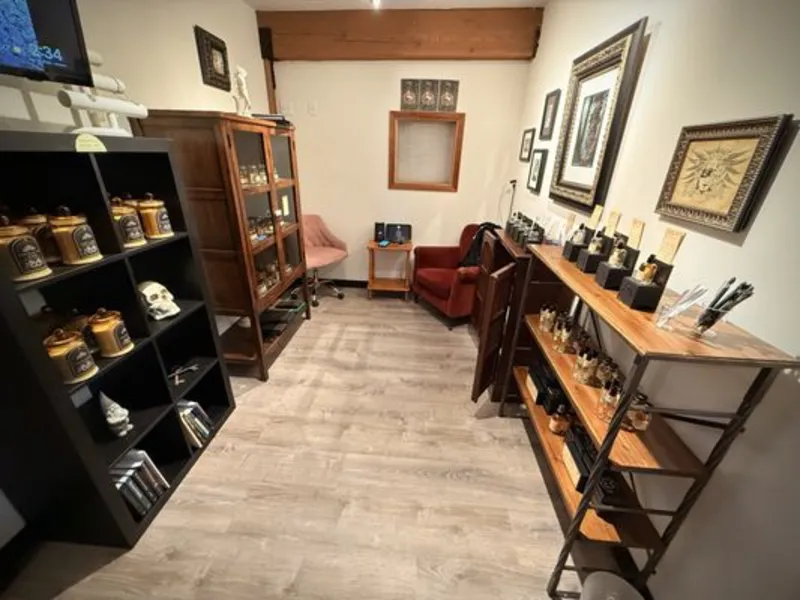
The community today has no census, its economy being for-hire: the readers and rootworkers' association provides an accreditation directory governed by a board, the reading room's fees running to the hundred-dollar mark for a session, and the online scene's boom has multiplied the tradition's visibility and its disputes alike. Access is contested, which is the honest answer: the tradition's history opens it, its current community debates it, and the person approaching should know both. Its counsel is the tradition's own: the work is specific, the diagnosis comes before the working, and the power is not the worker's own but is asked for, from the God the tradition's Bible invokes.
also known as Rootwork, conjure, southern conjure, root magic
Cultural family
Where it’s found
Access
Related traditions
Neighbouring lineages this tradition connects to.
16 practices
Ancestor Work
Honoring and working with one's dead: the ancestor altar and its offerings, the genealogical research as devotion, and the traditions the revival draws from.
Bibliomancy
Asking a question and opening a trusted book at random, letting the passage under the thumb or finger answer.
Bone Reading
Casting a personal set of bones, shells, and curios onto a cloth or the ground, and reading their fall, positions, and relationships.
Candle Magic
The candle as the spell: dressed, carved, and burned while the flame works the petition, the burn read for omens, the tradition codified in 1940s New Orleans.
Cartomancy
Divination with ordinary playing cards, read by suit, number, and adjacency, the older and plainer cousin of tarot.
Ceromancy
Molten wax or metal poured into cold water, the hardening shapes read as omens, with a candle-burning cousin in American rootwork.
Generational Healing
Healing the inherited: family patterns and lineage burdens addressed through constellations, genealogy, and ritual, with the science of inheritance beside the work.
Incense, Oil & Potion Craft
Making the magical preparations: incense blended and burned, condition oils made and named, the potions and philtres, and the supply trade that codified it all.
Magical Herbalism
Plants worked for their correspondences: the gathering formula and the enchantment, the sachet and the infusion, and the canon whose sources disagree with each other.
Pendulum Dowsing
Reading answers in the swing of a suspended weight, from yes-or-no questions to charts and maps, with a practice that runs from water witching to healing rooms.
Petition & Container Work
The written petition and the sealed container: name papers under candles and in shoes, the honey jar's sweetening and feeding, and the freezer spell's hoodoo antiquity.
Poppet & Doll Magic
The doll as the person: image magic from Egyptian execration figures through the trial records to the healing poppet and the voodoo-doll myth's correction.
Protection Magic
The defensive craft: wards and mirrors and bindings, the classical curse tablets' ancestry, the mass binding's viral moment, and the hex debates the practice hosts.
Spellwork
The practice of magical workings for goals: the spell's anatomy, the cunning folk's services, the revival's spell books, and the cast-for-you market they became.
Spirit Conjuration
The modern practice of calling and working with spirits: demonolatry's respect-based tradition, the goetic revival, rootwork's spirit calling, and the communities' own ethics.
Uncrossing & Curse Removal
Removing crossed conditions in the rootwork tradition: the diagnosis first, the herb baths and psalms, the egg and the candle, and the reading-first rule that guards it.
Go deeper
Immerse yourself
Learn it and visit it: courses that teach hoodoo & rootwork, and the places held sacred to it.



The lineages
Institutions & businesses
Organizations whose work centers on hoodoo & rootwork.