
Magical Herbalism
Magical herbalism is the practice of plants for their correspondences: the planetary ruler and the element and the power assigned to each herb, the materials of sachets and charm bags and incense and infusions and baths, the working distinguished from medicinal herbalism by its frame, the plant's symbolism rather than its pharmacology, though the two were braided together for most of the tradition's history, the split visible even in antiquity where the physician's text treats the herb medicinally while its magical reputation lives in the parallel folklore.
The correspondences' sources are the astrological herbals: the Renaissance physician's English herbal whose subtitle promises which planet governs every herb and the astrologically proper time of gathering, the gathering and drying rules the modern practice inherits descending from an astrological-physic book rather than a witchcraft one; the classical encyclopedia's planetary tables upstream. The tradition's modern canon is two books: the master book of herbalism of 1984 and the encyclopedia of magical herbs of 1985, the latter still in print and the market's standard, its author dead at thirty-six having defined the genre, and the green witch tradition the marketing's label for the practice, coined by one author and popularized by another's bestseller.
The calibration finding is the entry's most instructive: the practitioners' own concordance setting four hundred one plants' planetary rulerships side by side across the tradition's sources finds them disagreeing, the correspondences not a single stable canon but a family of overlapping ascriptions whose sources contradict each other, the honest practice knowing which source it follows rather than pretending the tables agree.
The practice's mechanics, read from the encyclopedia's own spell chapter: the gathering's spoken formula naming the herb and its ruler and the need while cutting; the enchantment, the word's older meaning being to sing to, the herb attuned in the bowl between two candles with the need chanted, done moments before use; the sachet's colored cloth and tied three knots; the infusion without metal and the bath and the ointment at the pulse points and the incense's nine-substance limit; and the two calendars' frame, the plant's growth cycle against the magical calendar, the standard rule letting the plant's health come before the moon's timing, the drying after the dew and the airtight storage and the old herbs returned to the earth.
The folklore record supplies the correspondences' depth: the mandrake's human root and lethal shriek and dog-pulled harvest, the rowan's anti-witchcraft career, the pentagram scar on each berry and the red thread rhyme and the crosses over the lintels on May Eve, and St John's wort's solstice blooming and the baptist's blood in the crushed buds, the midsummer amulet and the wound herb the rest of the year. The market sells the practice through the bulk-herb suppliers and the platforms' five thousand listings and the books in print. Access is open entirely, no initiation, the books and the herbs the whole on-ramp. The entry's counsel is the concordance's: the correspondences are a tradition's memory, not a chemistry, and the practice that knows its sources disagrees with itself is practicing honestly.
At a glance
- Category
- Herbalism & Natural Magic
- Origin of practice
- The correspondences from classical astrology and European folklore; the modern book tradition from 1982
- Access
- OpenOpen to all , no initiation required. What access means
Traditions
The living lineages this practice moves within.
Tools & Materials
The magical herbalist's tools are the plant and the word: the dried herbs in their jars, the mortar and the sachet cloths in the correspondences' colors, the cords for the three knots, the charcoal for the incense burned on, and the spoken formula that names the herb and its ruler and the need. The gathering kit adds the scissors and the basket and the two calendars' consultation, the plant's health ruling over the moon. The practice's texts are its canon: the astrological herbal upstream, the encyclopedias of the eighties, the green witch's bestsellers, and the concordance that shows the sources disagreeing. What the practice requires beyond the herbs is the enchantment: the singing-to done moments before use, herb by herb, the practice's difference from mere gathering being the word spoken over the material.
Elements & Concepts
The correspondence. The plant's assigned ruler and element and power: the practice's organizing idea, and the canon's disagreement its honest caveat.
The gathering formula. The spoken naming of herb and ruler and need while cutting: the practice's opening rite, inherited from the tradition's own texts.
The enchantment. The singing-to of the herb before use: the word's older sense restored, the attunement between the candles.
The sachet. The colored cloth, the enchanted herb, the three knots: the practice's signature artifact, carried or hung, its cord tied while the need is held in mind.
The organizations
Institutions & businesses
Organizations whose work centers on magical herbalism.
 Blue Eagle MetaphysicalShop
 Botanica Shango ProductsShop
 Lhasa Karnak Herb CompanyMain location
 Enchanted Botanicals & Magical ThingsEnchanted Botanicals (by appointment, mail PO Box 296 Camptonville)
 Dragon HerbariumMain location
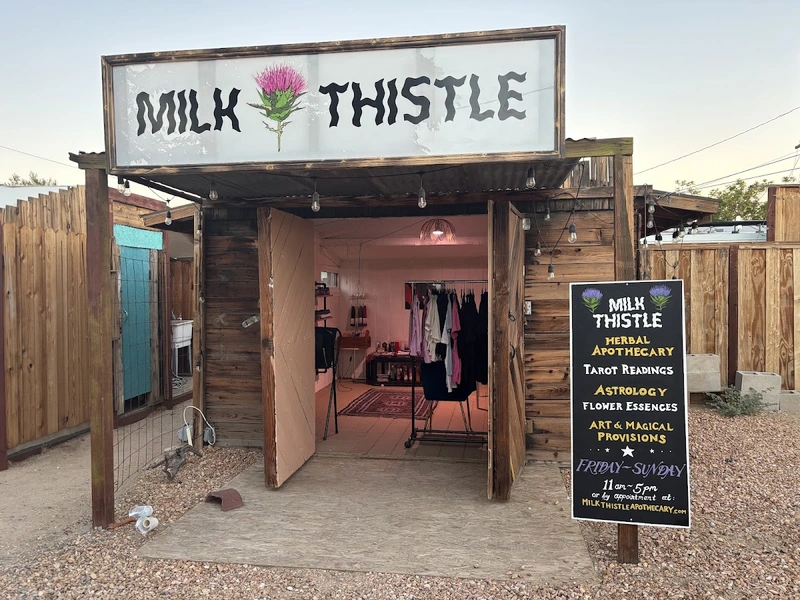 Milk Thistle Apothecary & TarotMilk Thistle Apothecary, Art Queen ComplexView allMore in magical herbalism





