Incense, Oil & Potion Craft
Incense, oil, and potion craft is the making of magical preparations: the incense blended from resins and herbs and woods, the condition oils named for what they fix, the potions and philtres brewed, and the sibling forms of sachet powders and washes and baths, one craft taught in one volume by the tradition's first non-academic book, the nineteen-thirties' legends of incense, herb, and oil magic whose author's pseudonym conceals an unknown identity and whose print run has never stopped.
The craft's histories are its forms'. The incense is the root, the word perfume meaning through smoke, the Egyptian temple's compound incense with its resins and honey and wine both religious and medical, the church's centuries of frankincense, and the doctrine of signatures' medieval herbals feeding the ascriptions the hoodoo oils inherited. The anointing oil's anchor is the biblical recipe, the oil for the light and the spices for anointing oil and the sweet incense, and the condition oils descend from the household practice, any oil dressed with herbs and prayed over, standardized and bottled and mailed by the supply houses from the late nineteenth century, manufactured in Chicago and Memphis and New Orleans and New York, the mass production beginning around 1900 and intensifying through the twenties and thirties, the imported ingredients replacing botanicals and the efficacy carried by color and scent and title, the products sold as curios to deflect the fraud laws, many of the houses Black-owned serving a segregated market.
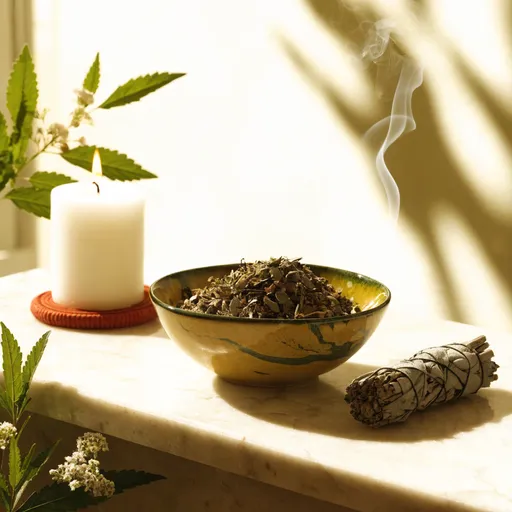
The naming splits by tradition and the entry keeps both: the hoodoo oils named for the condition, money drawing and uncrossing and the follow-me boy and the fast luck and the dressing-only formulas never worn, and the ceremonial oils named for planets and deities with parallel intents. The practice's methods are two: the solar infusion of herb in carrier oil and the blending of essential oils into the carrier, the terminology distinguishing the anointing of the body from the dressing of candles and mojo hands and money and petitions, the word fixing coming from the leather trade, and the condition oils made skin-safe so one bottle serves both. The incense's method begins always with the loose non-combustible blend, ground and burned on charcoal or kneaded with binder into sticks and cones, the resins ground in the mortar, the soft ones frozen first. The potion's tradition spans the philtres' history and the brews' recipes, the love potions' documented past and the alkaloid plants' chemistry.
The manufacturers' lines are the trade's modern canon: the Anna Riva line whose founder was a Detroit-born businesswoman and whose hundreds of gold-foil bottles passed to the successor company with formulas still proprietary, the private-label rebottling that keeps them in shops, the New Orleans seven sisters' iconic line, and the natural-ingredient line of the tradition's own historian. The market runs the small specialized niche the scholar documented across sixty shops, the platform's five thousand listings, and the craft books in print since the thirties. Access is open: no initiation, the trade books the teaching, the products sold to anyone. The entry's counsel is the craft's own: the preparation is the practice, and the formulas, mostly unpublished trade recipes, are the industry's property, which is why the entry teaches the class of work rather than the recipes.
At a glance
- Category
- Herbalism & Natural Magic
- Origin of practice
- Incense from the ancient temple traditions; the hoodoo condition-oil trade from the 1920s supply houses
- Access
- OpenOpen to all , no initiation required. What access means
Traditions
The living lineages this practice moves within.
Tools & Materials
The preparation crafter's tools are the mortar and the bottles: the resins ground with the soft ones frozen first, the woods chipped and powdered, the carrier oils and the essential oils for the two methods, the solar infusion's jar in the sun, the charcoal disk for the loose incense's burning. The kitchen adds the infusions' non-metal pots and the syrups and tinctures of the brews. The terminology is the practice's discipline: anointing for the body, dressing for the candles and the mojo hands and the money, the skin-safe formulation that lets one bottle do both. The tradition's texts are its manuals: the 1936 legends and its restoration, the encyclopedia of incense, oils, and brews, the big book of magical incense, and the scholar's history of the merchants. What the practice requires beyond the tools is the naming: the condition the preparation is made for, the label the tradition's own filing system, and the maker's intent the ingredient the trade cannot bottle.
Elements & Concepts
The condition oil. The oil named for what it fixes, drawn on candles and bodies alike: the craft's signature product, and the supply trade's codified line.
The loose incense. The non-combustible blend burned on charcoal: the oldest and most direct form of the craft, its recipe the maker's own.
The dressing. The fixing of candles and hands and petitions with oil: the practice's application verb, borrowed from the leather trade.
The philtre. The brewed potion, infusion or syrup or tincture: the craft's ingestible branch, its history the love potions' long record and its practice the recipes' precise parts.
The organizations
Institutions & businesses
Organizations whose work centers on incense, oil & potion craft.