Biofield Tuning
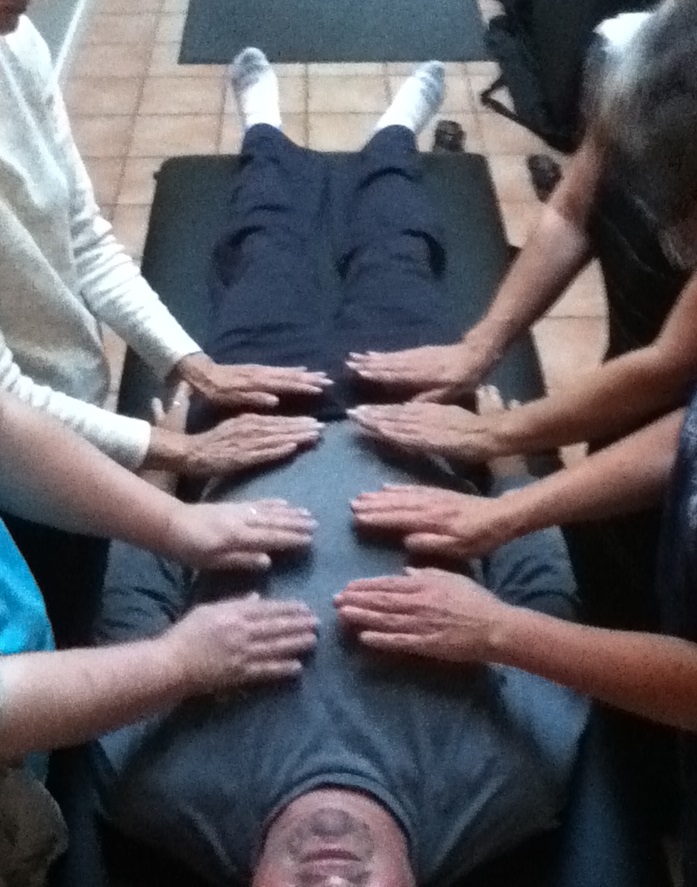
Biofield tuning works on the space around the body: the practitioner sounds a tuning fork at varying distances from a client lying on a table, reading the fork's tone and resistance as information about the field the method claims extends some five feet around every person, and working what it finds back toward the body. The method's map is its signature: the field read as concentric rings, the outer edge holding gestation and birth, each band inward corresponding to later years, like rings in a tree, so that resistance met at a given distance dates the charge to the age it was generated, and specific emotions assigned fixed positions, sadness off the left shoulder, anger off the right side of the body, the whole anatomy published in the founder's books. The session runs from the field's edge inward, the fork's dissonance marking what the method calls a perturbation, the tone held until the body settles it, the dissolved charge swept toward the midline, and the practitioner's skill is read in the fork's behavior rather than any instrument's.
The method's history is recent and its author documented: the massage therapist who bought a catalog set of forks in the nineteen-nineties, noticed the fork's sound changing by position around clients, and spent years mapping what she heard, the sonar analogy her own, the founder's accounts placing the founding case in 2005, a pocket of noise two and a half feet from a client's throat whose resolution coincided with the jaw pain's release. Her two books carried the method to its market, the institute and the training program building a practitioner corps, and the trademark she filed on the method's name was abandoned within a year and a half, the method's name now common property while its school's marks remain.
The method's own research is the entry's most instructive fact. The inter-rater study published in the alternative-medicine literature had three practitioners map ten subjects' fields and found little agreement among them, the journal's published finding, funded by the method's own institute, whose authors did not test whether the field exists at all; the institute's research page acknowledges the result and reframes it as the observer effect. The later feasibility studies, tiny and uncontrolled, report anxiety dropping after distance sessions, and a registered trial remains pending. The skeptical record runs alongside: the physicians' critique calling the method's evidence-gathering tooth-fairy science, the firsthand physics analysis noting that sound is mechanical vibration with no mechanism for tuning an electromagnetic field and that the founder's own book skips the physics, the body's real electromagnetic fields being tiny and near-field.
The market prices the training in the low thousands of dollars per level and sessions at the practitioner's rate, the founder's own clinic at the top of the range. Access is open, no prerequisites. The entry's counsel is the record's: the fork is audible, the map is the founder's invention, the practitioners could not agree on what they heard, and the method's claims rest on the premise its own funded study left untested. What the sessions deliver, by the relaxation evidence its neighbors share, is plausibly the relaxing effect of lying quietly while someone attends to you with sound, and the claims beyond that are the school's.
At a glance
- Category
- Energy & Spiritual Healing
- Origin of practice
- Vermont, United States; developed from a massage practice beginning in 1996
- Access
- OpenOpen to all , no initiation required. What access means
Traditions
The living lineages this practice moves within.
Tools & Materials
The biofield tuner's tools are the tuning forks and their activator: unweighted forks for the work in the field, weighted ones applied to the body, the hockey puck that serves as the sounding handle, and the practitioner's trained ear for the tone's changes. The training supplies the method's map, the anatomy chart of years and emotions, and the session's protocol, three sessions recommended as the minimum course, the detox response framed as expected. The institute's store sells the forks and the courses, the levels priced in the thousands, and the practitioner's certification is the school's own. The method's literature is its founder's two books and the small research record, the institute's page included, and the skeptical literature is part of the method's documented reception. What the practice requires beyond the forks is the map: the field's alleged structure is the method's interpretation, and without it the fork is only a fork.
Elements & Concepts
The biofield. The claimed field extending feet around the body, holding memory as standing waves: the method's premise, untested in its own research, and the map's substrate.
The biofield anatomy map. The concentric dating of the field, birth at the edge, the present at the body, emotions at fixed positions: the method's signature invention, and the interpretive frame every session applies.
The perturbation. The dissonance in the fork's tone marking what the method reads as stored charge: the session's diagnostic event, heard rather than measured.
The sweep. The combing of dissolved charge back toward the body: the method's corrective action, performed with the fork's sustained tone.
The organizations
Institutions & businesses
Organizations whose work centers on biofield tuning.