
By Bailey Romatoski ·
Geomantic divination is a method of reading answers from a chart of sixteen fixed figures, built from a series of random marks made on paper, sand, or earth. Ask a question, generate the marks, reduce them to a chart, and interpret what the figures say. It was one of the most respected divination systems of the medieval world, practiced from West Africa through the Middle East to Europe, and it is having a quiet revival among modern practitioners.
A short history
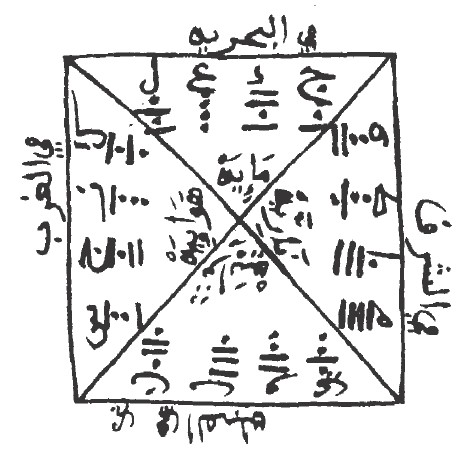
Despite the name, classical geomancy has little to do with feng shui or ley lines. The name comes from the Latin "geomantia," "divination by earth," and the system's Arabic practitioners called it ʿilm al-raml, the science of the sand (source: Emilie Savage-Smith, "Geomancy in the Islamic World," Springer Nature reference work; Wikipedia, "Arabic geomancy").
The practice developed in the Arabic-speaking world and spread with trade and translation. A beautiful surviving example is a geared geomantic instrument made in Egypt or Syria in 1241 to 1242 by Muhammad ibn Khutlukh al-Mawsuli, whose turning dials produced random dot designs for interpretation (source: Wikipedia, "Geomancy"). Latin translations brought geomancy to medieval Europe, where writers like Hugh of Santalla and later practitioners treated it as a learned art, and it stayed in European occult practice through the Renaissance.
West Africa holds a parallel lineage. Related systems of sand divination, such as sikidy in Madagascar, are practiced today and are recognized by UNESCO as intangible cultural heritage (source: Wikipedia, "Geomancy"; UNESCO, "Sikidy" entry at ich.unesco.org).
The sixteen figures
Every reading draws on sixteen figures, each a stack of four rows with one or two dots per row. In plain text they are: Via, Populus, Fortuna Major, Fortuna Minor, Conjunctio, Carcer, Acquisitio, Amissio, Laetitia, Tristitia, Albus, Rubeus, Puer, Puella, Caput Draconis, and Cauda Draconis. Each figure carries a core meaning. Via means movement, Carcer means restriction, Laetitia means joy, Tristitia means sorrow, Albus means clarity, Rubeus means turbulence. The figures pair as opposites, which is part of what gives the chart its balance.
How a geomantic chart is cast
A reading follows a fixed sequence, and it is simpler than it looks:
- Ask the question. One clear question, held in mind through the marking process.
- Generate four mothers. The practitioner makes lines of random marks, usually with pen strokes, dashes of sand, or tap counts, one line at a time, then reduces each line's marks to a single or double dot. Four lines make the first figure, the first "mother."
- Generate three more mothers. Repeat three times for four mothers total. This is where the randomness lives, and practitioners treat the marks as the raw signal.
- Derive the daughters. Each daughter comes from reading the rows of the mothers sideways, one daughter per row position. You now have eight figures.
- Build the shield chart. The remaining figures are produced by combining pairs of figures row by row, like adding without carrying, until the chart is filled. The two final figures are called the witnesses, and combining them gives the judge, the figure that answers the question.
- Read the chart. Interpretation weighs the judge, the witnesses, and the placement of figures in the chart's houses, each house covering a life area like home, partnership, or loss.
A practiced reader finishes the marking in a few minutes. The chart itself is done on paper with a pencil, which is one reason the system survived so well: it needs nothing but a page.
Geomancy in modern practice
Modern geomancers work with the same sixteen figures, though most have traded sand for notebooks and apps that speed up chart generation. The system appeals to people who like a structured, self-contained method: there is a right answer in the chart and a defined procedure for finding it, which sets it apart from more intuitive forms of divination. Practitioners often pair it with astrology, since each figure corresponds to a planetary and elemental attribution in the European tradition.
Learning the core procedure takes most people a weekend. Learning to read well takes longer, and geomancers say the skill grows with each chart you interpret.
Common questions
Is geomancy related to feng shui? Not really, and the shared "geo" prefix misleads a lot of people. Feng shui is a Chinese practice about siting and arranging spaces. Classical geomancy is a chart-based divination system from the Arabic tradition. They are entirely separate practices that happen to share a Latin name.
Do you need special tools? No. Pencil and paper cover it. Traditional practitioners used sand trays, sticks, or chalk, and today apps and websites can generate charts, but the tool was never the point.
How long does it take to learn? You can cast your first chart in an afternoon. Fluency in interpretation is a longer road, as with any divination system, and most practitioners say a few months of regular practice builds real confidence.
Is it accurate? That depends on what you believe divination does. Practitioners use it as a structured way to think through questions, surface intuition, and reflect. It is a practice with a long history, not a measured science, and it works best approached that way.
Can geomancy predict the future? Practitioners frame the chart as a reading of the present and the tendencies flowing from it, not a fixed prophecy. The judge figure answers the question as asked, and interpretation is where judgment enters.
Is it still practiced today? Yes, in several lineages. European revivalist practitioners, Arabic-tradition readers, and West African and Malagasy sand divination communities all keep the practice alive.