
By Bailey Romatoski ·
A charm is an object, word, or gesture charged with intention to protect, attract, or mark something as significant, and charm casting is the practice of creating one on purpose. It sits in the same family as amulets and talismans: small, portable pieces of meaning that people have carried for as long as there have been pockets. Whether the charm is a knot, a coin, a written word, or a stone from a river, the practice is the same in spirit. You put your intention somewhere you can keep it close.
What charm casting looks like
Here is how a charm gets made. The practitioner starts with an intention, usually something specific: safe travel, a calm mind, luck in a new chapter. Then they choose a vessel for it. Traditions vary wildly, but common forms include a knotted cord, a small bag of herbs, a written sigil, a coin worn smooth, or a pendant that gets its meaning assigned at the moment of making. The final step is the "charging" or "consecration," where the object is dedicated to its purpose through words, breath, touch, or time spent with it.
Because the charm is portable, the practice travels well. It needs no temple, no altar, no tool beyond the object itself. That is likely part of why it shows up in nearly every culture.
Where charms appear across traditions
Charm casting is one of the most widespread practices in the esoteric world. The English word itself is old and telling: it came into English around 1300 from Old French "charme," from the Latin "carmen," meaning song or incantation (source: Etymonline, "charm"). A charm was, at first, the spoken thing, and only later the object that carried it.
A few of the many places the practice shows up:
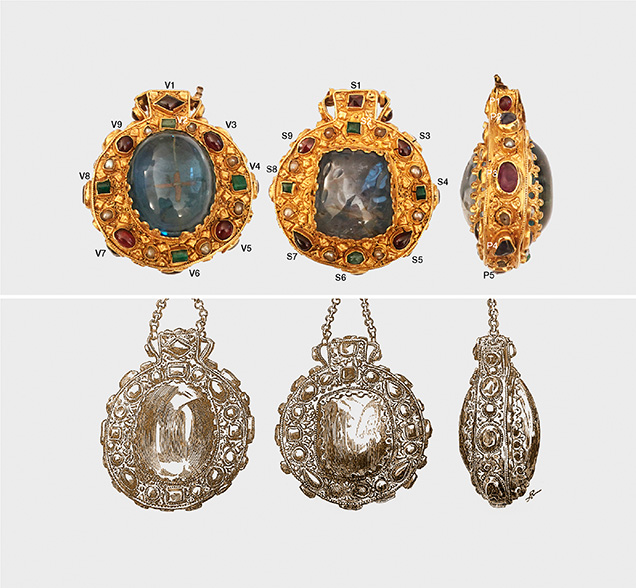
- Grave goods and amulets in antiquity. Archaeologists keep finding protective objects buried with their owners. The word "amulet" comes from the Latin "amuletum," an object believed to confer protection or grace on its holder (source: Wikipedia, "Amulet"). Third-century Roman rings carved to ward off the evil eye survive in museum collections today (source: Wikipedia, "Talisman").
- Islamic talismanic tradition. The word "talisman" arrived in English in the 1630s through French from the Arabic "tilsam," itself borrowed from Greek "telesma," a rite or consecrated thing (source: Etymonline, "talisman"). Inscribed metal and stone talismans were made across the medieval Islamic world.
- Folk magic in Europe. Knots, crib charms, hexagonal "shine" coins, and carved witch marks on doorposts all belong to the European folk layer of the practice. Many of these survive as heirlooms.
- Everyday modern forms. Hospital "miracle beads," army dog tags carried past their function, first concert tickets kept in a wallet. If you have ever carried an object because of what it means to you, you already know the psychology of a charm.
How practitioners work today
Contemporary charm makers usually blend old forms with personal meaning. A typical practice looks like this:
- Name the intention. Specific beats vague. "Peace in my home this winter" gives the charm something to hold.
- Choose the form. Some practitioners follow a tradition's rules (metal, day of the week, direction of the knot). Others work intuitively, picking whatever object already feels like the intention.
- Make it. Handmade matters to many practitioners because the act of making is the act of intending. A knotted cord made in one sitting is a common example.
- Charge or consecrate it. This is the moment the object becomes a charm: a spoken word, a held breath, a night under the moon, or simply a quiet minute of focus.
- Keep it where it works. Pinned inside a coat, hung over a door, in a pocket, under a pillow. Placement is part of the practice.
There is no licensing body and no single canon. Practitioners often describe the charm less like a battery and more like a reminder: an external anchor for an internal state.
Charm, amulet, talisman: what is the difference?
People use these words interchangeably, and honestly that is fine in casual conversation. In stricter usage, an amulet protects against something (the evil eye, illness, bad luck), a talisman attracts or empowers something (fortune, eloquence, a specific outcome), and a charm is the broader word, originally for the spoken incantation and later for the object and its effect (sources: Wikipedia, "Amulet"; Etymonline, "charm" and "talisman").
Common questions
Is charm casting safe? Yes. The risks involved are the ordinary ones: if you are burning things, mind the flame, and if a charm is meant to replace medical care, it should not. Practitioners across traditions treat charms as companions to practical help, not substitutes for it.
How much does it cost? It can cost nothing. A knot in a cord, a stone, a scrap of paper. Craft charms from makers range from a few dollars to a few hundred depending on materials and time. The tradition itself has no price tag.
Do I need to be religious? No. Charms exist inside religious traditions and outside them. Plenty of people who practice charm casting describe themselves as spiritual but not religious, and many religious people carry charms without seeing any conflict.
Is charm casting the same as a talisman or amulet? They overlap. Strictly, amulets protect, talismans attract, and charm is the umbrella word. If you tell a jeweler you want a "charm," they will show you something very different from what a folk practitioner means, which is worth knowing before you shop.
Can I make one for someone else? In most traditions, yes, and gifted charms are a long human habit. The common courtesy is to ask the person first, since the charm works best when its owner knows what it is for.
Does the charm lose its power? Traditions differ. Some practitioners re-charge charms seasonally, others retire them when the intention is fulfilled. Treating a charm as finished once its intention lands is a common and graceful end.